


 Spotlight Radio
Content Marketing vs Paid Ads: Which One Actually Drives Long-Term Traffic for Your Business?
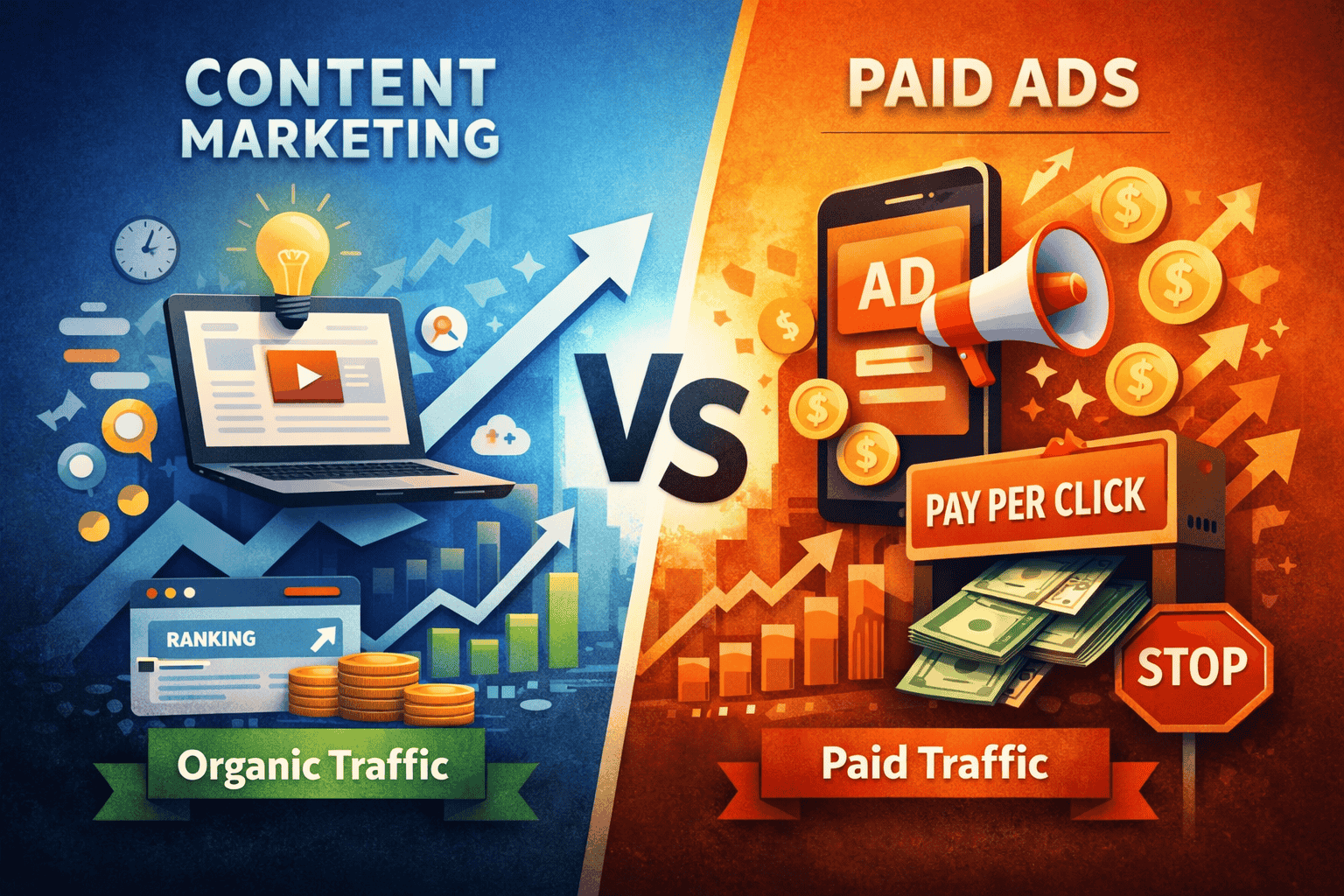
Most businesses are not struggling with marketing. They’re struggling with visibility that lasts longer than a campaign budget.
A company launches ads, traffic spikes for a few weeks, leads come in, and everything looks promising. Then the campaign ends, and the visibility disappears with it.
No steady search traffic, no ongoing discovery, and no digital footprint that continues working after the budget stops. That cycle is more common than many founders realize.
The question is not whether ads work. They do. The real question is something deeper:
What actually builds traffic that lasts beyond the campaign?
That’s where the conversation between paid ads and content marketing becomes important.
The problem is that most businesses don’t have the time, resources, or internal expertise to build either properly. So they end up spending money on ads that stop working the moment the budget runs out, while their website sits quietly on the internet with little or no organic traffic.
Paid ads are powerful; they are the fastest way to rent attention. And no, I’m not anti-ads; after all, platforms like Google and Meta built billion-dollar ecosystems around advertising for a reason, but it is content that gives you equity. And equity compounds.
What Paid Ads Actually Do
They buy you placement, they give you speed.
You pay to show up for keywords like
-
“best accounting software”
-
“real estate investment in Lagos”
-
“affordable skincare brands”
You get traffic immediately, but here’s the part many founders don’t calculate:
When you stop paying, your visibility disappears.
Every click has a cost. Every impression is borrowed attention. And the moment your budget tightens, so does your traffic.
It’s like paying rent every month without ever owning the property. If your business depends only on ads, you are building on a subscription model you don’t control.
For companies with large marketing budgets, this might not be a major issue. But for startups, small businesses, or growing brands trying to manage costs carefully, relying entirely on ads creates a fragile growth system.
It becomes an expensive cycle: Spend money → get traffic → stop spending → lose traffic.
Content Marketing: Here Comes the Bride!
Like a bride walking slowly down the aisle to become a Mrs., content marketing is the slow engine that takes longer to start, but its impact compounds over time into searchable authority.
When you publish search-optimized content on your website, blog, or social space, you are building assets that keep ranking, attracting, converting, and working when you’re offline and long after it’s published.
One well-written article targeting the right keyword can bring traffic for 2–5 years without additional spend, and that’s how search ecosystems work. Unlike ads, the content becomes an asset. It lives on your website, strengthens your domain authority, and keeps bringing people back.
And most importantly, it allows potential customers to discover you when they are actively searching for solutions. This is the difference between interrupting people with ads and being found by people who already need what you offer.
The Real Challenge Businesses Face
If content marketing is so powerful, why don’t more companies do it properly?
It is because creating traffic-driving content is not the same thing as simply writing blog posts.
Many businesses launch a website, publish a few articles, and then wait.
Nothing happens. No traffic. No ranking. No visibility.
The reason is that most of the content online is not structured for search engines. It usually lacks keyword intent, doesn’t address real search queries, and isn’t organized into topical authority clusters.
So the content exists, but it remains invisible. This is where strategy matters.
The Compounding Effect Most Businesses Ignore
Here’s what happens when content is done right:
Month 1: Minimal traction
Month 3: Search impressions increase
Month 6: Organic traffic stabilizes
Month 12: You’re getting leads without daily ad spend
Search engines reward consistency, relevance, and authority.
If your content answers real search intent and is structured properly, platforms like Google begin to index you as a solution provider, not just another website. That’s when traffic becomes predictable, not viral.
“But I Don’t Have Time to Create Content”
Exactly. That’s the problem.
Most businesses don’t have time to research keywords, study search intent, build content clusters, optimize metadata, structure internal links, or track performance.
Of course, you shouldn’t have to. Content strategy is a technical discipline, not a side task. And that’s why you have me, 🤷♀️ a Content Strategist who is ready to help your company turn content into traffic, visibility & revenue.
You don’t need to become a content expert. Your job is to run your business. While I help you reach that goal of driving long-term traffic and structure your content so it becomes your silent sales team working 24/7 without ad spend.
So, Which Should You Choose?
Well…, they are both capable of serving as a bridge between both worlds.
If you need immediate visibility for product launches, promotions, and time-sensitive campaigns, paid ads make sense.
But if you want sustainable website traffic, reduced dependency on ad spend, authority in your industry, and leads that find you without constant promotion, then content marketing is non-negotiable.
The smartest brands don’t choose one.
They use paid ads to amplify high-performing content for speed. But first, they build content that search engines actually recognize and recommend.
I recently wrote about How to Create Content That Search Engines Actually Recommend, and that piece breaks down how search intent, keyword layering, and topical authority determine whether your content survives beyond 48 hours. If you want your content to move from “posting” to “ranking,” go read that next. It connects directly to this conversation.
That’s the foundation. Without that structure, even your paid ads are driving traffic to weak assets.
A Quick Look at the Numbers
Research across multiple marketing studies consistently shows the long-term advantage of organic traffic.
Content marketing typically costs 60% less than paid advertising while generating around 3 times as many leads over time.
More importantly, organic search drives a significant portion of web discovery for businesses across industries. This explains why the strongest digital brands rarely depend on ads alone. They build content ecosystems that continuously attract new visitors.
A Visual Way to Think About It
Imagine two businesses.
Business A spends $2,000 monthly on ads for 12 months.
Business B invests in building 24 strategic search-optimized articles in 12 months.
At the end of the year:
-
Business A has spent $24,000 and must keep spending to maintain traffic.
-
Business B owns 24 digital assets that can rank for years.
One rented visibility.
One built a digital property.
Which one feels more stable?
The Strategic Shift Most Companies Need
Every month you delay building search-driven content, your competitors deepen their authority. The longer someone publishes optimized content, the harder it becomes to outrank them.
If your brand is currently depending only on paid ads, this isn’t a warning. It’s an opportunity to start building what compounds, amplify what performs, and stop renting attention when you can own it.
If you are ready to become discoverable for the next 3 years, send me a DM. Let's build a strategic system that turns content into traffic for your business.
Why This Matters More Today Than Ever
The internet is no longer a place where brands simply “exist” online. It is a competitive discovery ecosystem.
When someone searches for solutions to business problems, recommendations, industry insights, or product comparisons, search engines decide which brands become visible. If your business doesn’t appear in those search moments, you’re invisible to a large part of your potential audience.
And that invisibility has nothing to do with the quality of your product. It usually comes down to content strategy.
I’d like to hear from you…
Before you leave, here’s something worth thinking about...
If your paid ads stopped running tomorrow, would your business still receive consistent traffic from search engines and organic discovery?
Or would your visibility disappear the moment the ad budget pauses?
I’m curious to hear how businesses are approaching this right now:
Are you relying more on paid ads for traffic, or are you intentionally building content that brings long-term organic visibility?
Share your experience below; what has worked for your brand so far?


